The Ultimate Machinery Technologies Showcase of the Year

Pubblicato il 06/10/2025
The Ultimate Machinery Technologies Showcase of the Year

MAKTEK Konya: The Epicenter of Technology and Investment Potential

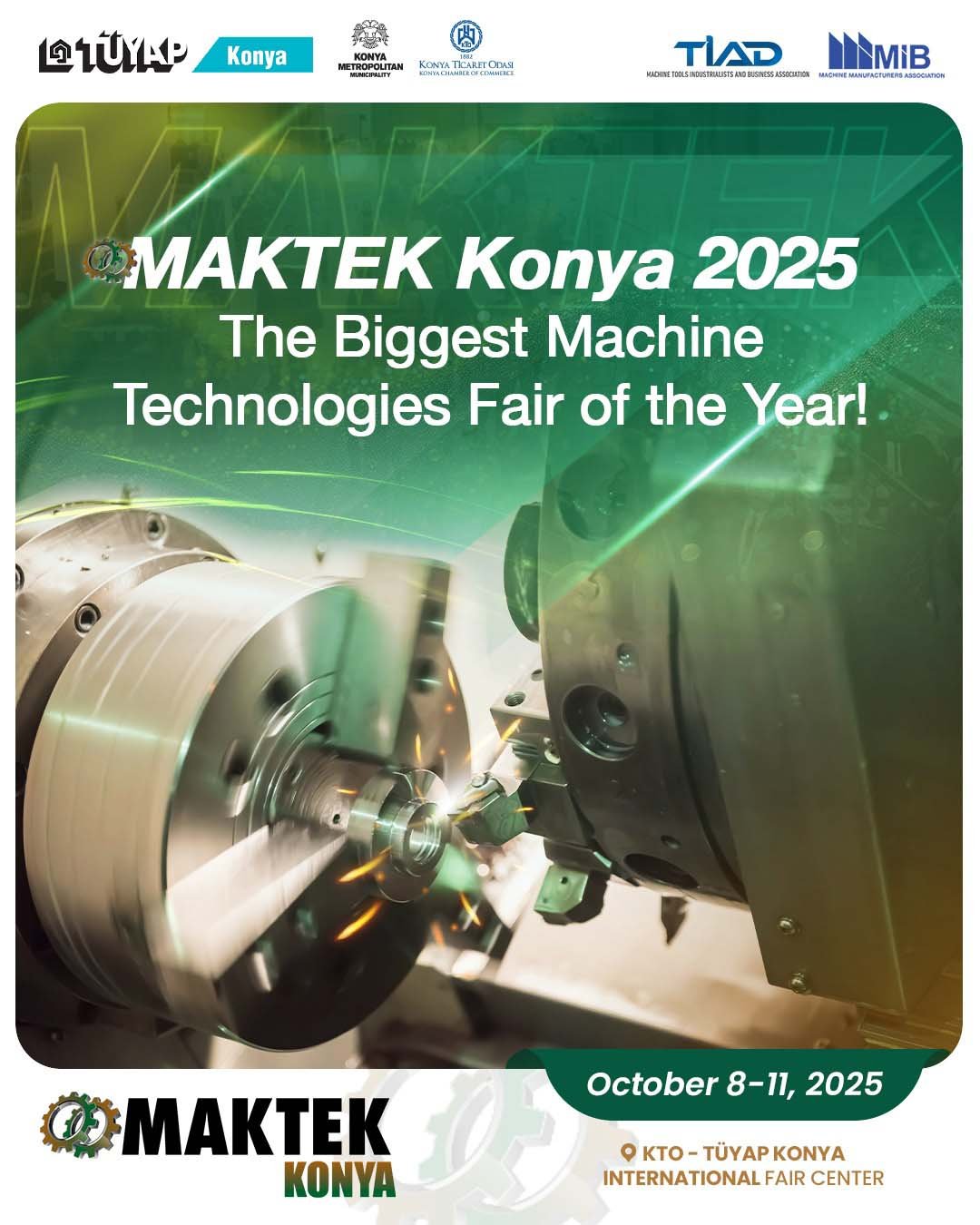
MAKTEK Konya serves as a pivotal assembly point for the machinery manufacturing sector and is actively engaged in preparations to unite the industry under a single venue in Konya, recognized as the production hub of Anatolia. As the largest machinery exhibition of the year, this event will showcase the latest technologies and the most reputable brands within the industry, contributing to an increase in trade volume for this year.

 
The 3rd Edition of MAKTEK Konya – Machine Tools, Metal-Sheet Metal Processing Machines, Tool Holders, Cutting Tools, Quality Control – Measurement Systems, CAD/CAM, PLM Software, and Manufacturing Technologies Fair – is scheduled to take place from October 8 to 11, 2025, at the Konya Chamber of Commerce – TĂĽyap Konya International Fair Center. This event will be organized by the TĂĽyap Fair Organization Group in collaboration with the Machine Tools Industrialists and Business People Association (TIAD) and the Machine Manufacturers Association (MIB). 
 
A pivotal assembly point in Konya, the epicenter of technology 
The upcoming exhibition is set to take place over a sizeable area of 45,000 square meters, allocated across four halls. This event is anticipated to attract over 20,000 participants from both local and international backgrounds. Notably, this year, InnoPark Konya Technology Development Zone, a key player in the innovation and entrepreneurship ecosystem of Konya, will also participate in the exhibition.

A pivotal assembly point for international trade
MAKTEK Konya is poised to serve not only as a focal point for TĂĽrkiye but also as a hub for numerous international attendees from various countries. This year, substantial participation is anticipated, particularly from representatives from countries including Algeria, Morocco, Tunisia, Egypt, Romania, Iraq, Germany, Kazakhstan, Saudi Arabia, Italy, and France.

While the initiatives aimed at attracting international visitors continue to gain momentum, bolstered by the robust foreign office network of TĂĽyap, specialized procurement committee programs will be organized to facilitate direct business interactions between purchasers and sector representatives from the targeted markets and exhibitors. Consequently, Maktek KONYA is set to evolve into a significant business platform, where not only product exhibitions will take place but also new commercial partnerships will be established. 
 
A dynamic platform for the sector
MAKTEK Konya 2025 will showcase a comprehensive selection of products that highlight a diverse range of machining and metal forming machines, including CNC machining, sheet-metal processing, and saw machines, cutting and holding tools, CAD/CAM, and PLM software. The exhibition will also feature welding machines, electric-electronic and automation systems, gears, sub-industry equipment, compressed air technologies, and logistics solutions. 
 
Green Transformation Summit and Exhibitor Panels
The upcoming exhibition will feature a noteworthy initiative entitled the “Green Transformation Summit”. This summit will provide an opportunity for leading companies in the industry to share their insights and perspectives on sustainability and green manufacturing practices. Key topics for discussion will include energy efficiency, digitalization, strategies for reducing carbon footprints, and the principle of a circular economy. 
 
The “Exhibitors Talking” sessions, to be conducted at the summit, will introduce a novel dimension to MAKTEK Konya. This specialized program will facilitate the exchange of best practices and innovative solutions in green transformation among participating companies and industry professionals, aiming to foster information sharing and pave the way for new collaborative opportunities. 
 
As the largest machinery exhibition of the year, MAKTEK Konya serves as an essential forum for industry professionals to explore the latest technological advancements within the sector, foster new business relationships, and closely examine the emerging manufacturing trends of the future.
 
The exhibition will be accessible to visitors from 10:00 AM to 7:00 PM from October 8 to 10, and from 10:00 AM to 06:00 PM on October 11.
 
About TĂśYAP: TĂĽyap was established by BĂĽlent Ăśnal in 1979 as the first fair organization company in TĂĽrkiye. Since its inception, the TĂĽyap Fair Organization Group has successfully hosted numerous domestic and international fairs over a span of 45 years, positioning itself as a leader in the development of fair organization within TĂĽrkiye. Throughout these events, TĂĽyap has facilitated the participation of over 350,000 firms from various countries and has welcomed more than 70 million visitors. The company organizes specialized fairs and operates international offices in six countries, in addition to possessing and managing three exhibition centers within Turkey. TĂĽyap collaborates with over 100 trade associations, leveraging its team of professionals to enhance the quality and effectiveness of its events. Moreover, TĂĽyap conducts export product fairs in China, Russia, and Africa, and consistently organizes Turkish participation in an average of ten international fairs each year. Notably, TĂĽyap is the only privately owned fair organization in Turkey with a dedicated fair center. Furthermore, the TĂĽyap Fair Organization Group continues to innovate by organizing hybrid fairs utilizing digital platforms.
 
Follow TĂĽyap Fair Organization Group on social media accounts: 
Instagram: @tuyapfuarcilik
LinkedIn: /tuyapfuarcilik

Per maggiori informazioni: MAKTEK Konya

Altri articoli che potrebbero interessarti

Amada machinery presenta la nuova ssr5

Rettificatrice AMADA SSR5: la scelta ideale per chi vuole combinare l'elevata capacitĂ  di asportazione con la massima precisione e velocitĂ , semplificando il lavoro dell’operatore.Vantaggi del suo utilizzo:âš™ VelocitĂ  triplicata: fino a 3 volte piĂą veloce rispetto alle rettificatrici convenzionali, grazie all'eliminazione intelligente dei movimenti a vuoto.âš™ Precisione estrema: garantisce una qualitĂ  di finitura superficiale e una planaritĂ  nell'ordine di pochi micron.âš™ Lavorazione potente: eccellente capacitĂ  di asportazione anche su materiali particolarmente ostici come metallo duro e acciai sinterizzati, con minore usura della mola.La SuperioritĂ  della SSR5: derivante da scelte costruttive mirate: đź’ˇ Design a rigiditĂ  ottimale: struttura monolitica in ghisa di alta qualitĂ  e grande spessore per garantire la massima stabilitĂ .đź’ˇ Separazione dei movimenti: netta separazione tra i componenti del movimento trasversale e quelli rotativi, massimizzando l'efficienza.đź’ˇ Componenti top di gamma: guide idrodinamiche raschiettate a mano per una precisione insuperabile e mandrino di rettificaidrodinamico con stabilizzatore di temperatura per una stabilitĂ  termica costante.đź’ˇ FacilitĂ  d'uso: pulsanti tattili e volantini elettronici.đź’ˇ Programmazione intuitiva: macro realizzate dal costruttore e controllo CNC Fanuc rendendo la macchina estremamente facile da utilizzare.

The smarter grinding wheel gives way

How elastic bonded diamond tools optimize precision machiningWhen the hardest material in the world and soft plastic come together, the result is tools with very special grinding properties. We are talking about elastic bonded diamond grinding wheels. These show their strengths during finishing and ensure the perfect finish. Innovative processes such as these are necessary because the manufacturing industry faces the challenge of producing increasingly complex and precise components from resistant materials. Conventional production methods often reach their limits here, especially when the surfaces are so fine that they require particularly sensitive processing. At the GrindingHub trade fair, organized by the VDW (German Machine Tool Builders' Association) in Stuttgart from May 5 to 8, 2026, visitors will learn more about innovative grinding techniques for achieving the highest surface qualities.

For demanding finishing and polishing processes
Elastic grinding and polishing tools are used in a wide variety of industries. In metalworking, they refine surfaces ranging from the finest surgical instruments to heavy-duty turbine blades. These tools can be used to accelerate manufacturing processes and increase cost-effectiveness and sustainability in production. "Our elastic bonded diamond tools demonstrate their strengths wherever extremely hard materials such as carbide need to be machined with precision," says Jens Meiberg, Head of Technology Development at GrindingHub exhibitor Artifex Dr. Lohmann GmbH & Co. KG, a specialist in elastic grinding and polishing tools based in Kaltenkirchen near Hamburg. "They achieve their maximum effect particularly in applications where extremely fine surfaces, even mirror finishes, are required," says Meiberg. This makes them ideal for demanding finishing and polishing processes. According to Meiberg, Artifex is currently focusing on the machining of carbide drilling and milling tools to improve cutting edges and achieve more efficient chip removal from cutting tools.

Greater efficiency and reduced overall costs
Technically optimal surfaces are one thing, cost-effectiveness is another. In industrial practice, it ultimately comes down to the cost-benefit analysis for the user. In other words: When does the improved surface quality justify the higher cost? "Studies show service life improvements of more than 50 per cent compared to unprepared tools," says Artifex manager Meiberg. Combined with faster chip flow and greater chip volume, users achieve significant cost and service life advantages. Machining with elastic bonded diamond tools significantly improves the surface quality of the machined workpieces. In practice, this optimization leads to noticeably longer service life for subsequent tools and more stable and reliable process behavior. Users benefit from greater efficiency and reduced overall costs," says Meiberg.

Delicate machining for delicate surfaces
Some surfaces are so delicate that they must be machined with extreme care. As the Head of Technology Development at Artifex explains, flexibly mounted diamond particles achieve "non-contour-changing glossy surfaces" by cutting topological material peaks. The homogeneously distributed abrasive medium bounces back and forth in the bonding matrix. Put simply and in layman's terms: the soft mass gives way slightly, so that the grains wobble slightly when rubbed instead of scratching firmly. Therefore, the surface is only gently smoothed and polished, rather than aggressively removing material or changing the shape. In other words: the smarter grinding wheel gives way. "The pressure and speed parameters of the process pose the greatest challenge in preventing grain break-outs from this newly developed soft bond," says Meiberg. The surface quality can be achieved reproducibly throughout the entire life cycle of the disks. Thanks to the tool change options in the machine, machining is carried out in a single clamping and not through downstream processes. According to Meiberg, Artifex's in-house Research and Development Department ensures the continuous advancement of diamond tools – particularly with regard to new carbide alloys and modern carbide tools.Scope for basic research down to the nanometer range
There is still plenty of scope for basic research at universities in the micro- and nanometer range. This also applies when using flexible precision machining tools in the finishing of structured surfaces. Dr. Monika Kipp, who heads the Grinding Technology Department at the Institute of Machining Technology at the Technical University Dortmund, is intensively involved in this topic. "One example of the use of flexible precision machining tools is the finishing of structured surfaces," says Kipp. If these are produced by milling, for example, micro-burrs may occur. In order to remove these without significantly altering the structure and at the same time improving the surface finish, the tools must be highly adaptable and only a very small amount of material should be removed. "To achieve this goal, our research focuses on the fundamental process behavior of flexible diamond tools," says the scientist, who was recently awarded the Otto Kienzle Commemorative Medal by the WGP (Scientific Society for Production Engineering).

Perfect choreography
When machining highly sensitive surfaces with flexible tools, it is essential to know exactly how the tools and material interact. "In order to avoid unwanted contour changes in precision machining with elastic bonded diamond grinding wheels or other flexible grinding tools, it is essential to understand the basic process interactions," says Kipp, summarizing the key challenge. This includes, for example, coordinating the process parameters and the bonding strength or flexibility of the tools and thus the local contact situation. In addition, according to the scientist, targeted adjustments to the process control with regard to the kinematics of the procedure could also be effective. In layman's terms, you can imagine it as choreography. How fast does the grinding tool move? How fast is the workpiece moving? At what angle or pattern do the grains strike the surface? How often does a single grain engage with the material? For optimal results, perfect coordination is essential.

Three factors: contact pressure, contact time, grain sizeThe surface quality in precision machining depends, among other things, on the local contact situation, says Kipp. "When it comes to process design, a distinction must be made in terms of the objective: whether the aim is to achieve the lowest possible roughness or whether functional surfaces with structural or contour elements need to be reworked," explains the researcher. Flexible abrasive tools can be used for corresponding applications. Material removal and thus the surface finish can be controlled by adjusting the contact pressure, contact time, and grain size, among other factors.The grinding gap is a mystery
Applications at the limits of what is technically possible and economically viable therefore open up a wide field for industrial and academic research. Because the saying among experts still holds true: "The grinding gap is a mystery." This phrase suggests that practitioners and researchers still need to shed light on the deepest physical and process engineering secrets of grinding in order to technically optimize industrial production processes and make them more efficient and sustainable.

L’industria italiana della macchina utensile archivia un 2025 piuttosto fiacco. per il 2026 e’ p

Dopo un 2024 davvero complicato, il 2025 è risultato piuttosto fiacco per i costruttori italiani di macchine utensili, robot e automazione che hanno visto crescere di poco la produzione, frenata dal calo dell’export a cui non si è contrapposta una sufficiente ripresa dell’attivitĂ  sul mercato interno. Il 2026 sarĂ  migliore ma le previsioni sono cautelative a causa della forte instabilitĂ  del contesto. Questo, in sintesi, quanto emerge dai dati di preconsuntivo 2025 e previsione 2026 appena rilasciati dal Centro Studi & Cultura di Impresa di UCIMU-SISTEMI PER PRODURRE. In particolare, nel 2025, la produzione si è attestata a 6.420 milioni di euro, segnando un incremento dell’1,5% rispetto all’anno precedente. L’anno è stato caratterizzato da una forte contrazione dell’export che si è ridotto a 3.710 milioni, il 13,2% in meno del 2024. Quasi tutti i principali mercati di destinazioni del made in Italy settoriale hanno registrato segno meno, a conferma della difficile situazione internazionale.Secondo l’elaborazione UCIMU sui dati ISTAT, nel periodo gennaio-settembre 2025 (ultimo dato disponibile), principali mercati di sbocco dell’offerta italiana di sole macchine utensili sono risultati: Stati Uniti (423 milioni di euro, -8,1%), Germania (196 milioni di euro, -29,7%); Francia (145 milioni, -0,5%), India (135 milioni -4,2%), Polonia (135 milioni, +13,3%). Sul fronte interno la ripresa del consumo, cresciuto del 20,5% a 4.465 milioni, ha trainato la crescita delle consegne dei costruttori italiani sul mercato domestico che si sono attestate a 2.710 milioni, il 32% in piĂą rispetto all’anno precedente. Nonostante gli incrementi di questi due indicatori siano significativi, i risultati sono poco soddisfacenti perchĂ© restano ancora molto inferiori ai valori ottenuti negli anni precedenti.Il dato di export/produzione è tornato a scendere fermandosi a 57,8% Per il 2026, le previsioni elaborate dal Centro Studi UCIMU indicano una crescita (ancora) moderata dei principali indicatori economici. In particolare, nel 2026, la produzione crescerĂ , attestandosi a 6.590 milioni (+2,6% rispetto al 2025).Tale risultato sarĂ  determinato sia dal ritorno in campo positivo delle esportazioni (+0,7%) rispetto al valore del 2025, attestandosi a 3.735 milioni di euro, sia dall’incremento delle consegne dei costruttori italiani che cresceranno a 2.855 milioni di euro (+5,4% rispetto al 2025), sostenute dall’aumento della domanda domestica.Il consumo italiano di macchine utensili, robot e automazione crescerĂ  a 4.730 milioni, pari al 5,9% in piĂą rispetto al 2025. Anche le importazioni potranno giovarsi della ripresa della domanda interna, come dimostra il dato di previsione che indica una crescita, del 6,8%, a 1.875 milioni di euro.Il dato di export/produzione scenderĂ  ancora, fermandosi a 56,7%.Riccardo Rosa, presidente UCIMU, ha così commentato: “Dopo un 2024 davvero complicato, il 2025 si è confermato l’anno di inversione di tendenza con il passaggio dal segno meno alla crescita, seppur timidissima, registrata dal dato di produzione. In realtĂ  non ci aspettavamo fosse l’export a zavorrare il risultato finale come invece è accaduto. â€śL’instabilitĂ  geopolitica internazionale, i conflitti aperti in Europa e Medio Oriente, la guerra dei dazi del presidente Trump e il conseguente nuovo (dis)ordine del commercio mondiale hanno messo a dura prova le nostre esportazioni”.“Meglio del previsto è risultata invece la performance che i costruttori italiani di macchine utensile hanno raccolto sul mercato interno dove, però, hanno recuperato solo una piccola porzione del terreno perso nel biennio precedente complici le criticitĂ  legate a Transizione 5.0 che, dopo essere partita con imperdonabile ritardo, ha subito diversi aggiustamenti, divenendo facilmente utilizzabile solo negli ultimi mesi di operativitĂ , salvo poi chiudere improvvisamente con piĂą di un mese di anticipo sul termine fissato al 31 dicembre”.“Nonostante le numerose difficoltĂ  riscontrate - ha continuato il presidente Rosa - i risultati ottenuti hanno però dimostrato l’utilitĂ  del 5.0, oltre ovviamente al 4.0, come misura volta a sostenere gli investimenti in nuove tecnologie di produzione in Italia”.“L’auspicio è che i provvedimenti di incentivo previsti dagli organi di governo in discussione in queste settimane di definizione della Legge di Bilancio 2026, siano effettivamente di semplice utilizzo e rapida operativitĂ . Noi costruttori italiani di macchine utensili - ha continuato il presidente di UCIMU - chiediamo semplicemente chiarezza e immediatezza. Per funzionare, la misura deve prevedere poca burocrazia e deve essere rilasciata e resa disponibile fin dalle prime settimane dell’anno nuovo. Solo così il provvedimento - che sulla carta, per come lo abbiamo conosciuto, ci sembra complessivamente valido - potrĂ  portare reali benefici al manifatturiero del paese”. â€śDetto ciò - ha aggiunto Riccardo Rosa - apprezziamo molto il recentissimo annuncio del governo di voler puntare sulla pluriennalitĂ  del provvedimento. Poter disporre di una misura dall’inizio del 2026 al 2028 è certamente una scelta oculata, in grado di permettere alle aziende clienti di pianificare gli acquisti, e ai costruttori di organizzare la produzione, così da distribuire al meglio il lavoro rispetto alla propria capacitĂ  produttiva”.“Sul fronte estero l’indebolimento di alcuni mercati, a partire dalla Germania travolta dalla crisi dell’automotive, la difficoltĂ  delle vendite negli USA, nostro primo mercato di sbocco, a causa dei dazi, la chiusura di alcune aree particolarmente ricche di opportunitĂ  come la Russia, impongono un lavoro ancora piĂą intenso per lo sviluppo delle relazioni commerciali con le aree tradizionali e con quelle “alternative” tra cui i paesi dell’Area del Mercosur. Per tale ragione - ha continuato Riccardo Rosa - desta sconforto leggere sui giornali che l’Italia è tra i paesi che mettono in dubbio il prosieguo dell’iter per la chiusura dell’Accordo EU-Mercosur, di fatto, giunto al rush finale. Tornare sui propri passi ora, in un momento particolarmente delicato per il commercio internazionale, sarebbe un grave errore”. â€śAnche sulla base di questo accordo, nell’ultimo biennio, l’associazione ha potenziato le sue iniziative dedicate ai paesi dell’America Latina. Oltre alle missioni esplorative svolte in Brasile, pensate per rafforzare le partnership con il sistema locale fatto di istituzioni, imprese e organizzazioni di rappresentanza, UCIMU ha avviato interessanti interlocuzioni con le organizzazioni di rappresentanza industriale dell’Argentina propedeutiche a nuove collaborazioni tra le industrie dei due paesi. Oltre a ciò - ha aggiunto il presidente Rosa - non abbiamo tralasciato i cosiddetti “paesi associati” e “osservatori” legati all’accordo, certi che anche questi potranno offrire opportunitĂ  interessanti alle nostre imprese. Tra gli associati al Mercosur abbiamo volto l’attenzione al Cile ove, a seguito di una missione di ricognizione, è stato messo allo studio un progetto di sviluppo di un Centro Tecnologico con la partecipazione di universitĂ  locali. Tra gli osservatori, invece, il nostro obiettivo è puntato sul Messico dove, da inizio 2025, è operativa l’Oficina Italiana de Promotiòn Mexico, un desk che opera per supportare le aziende italiane, nell’attivitĂ  di conoscenza e penetrazione del mercato rilevante, anche per l’area del Centro e Nord- America”. â€śCon riferimento all’Asia, India e paesi del Sud est asiatico sono per noi osservati speciali perchĂ© caratterizzati da una crescita molto forte e da una buona predisposizione nei nostri confronti, come dimostra la dinamicitĂ  delle attivitĂ  sostenute dalla associazione: dal Desk India alla Rete ITC India e alla Rete IMT Vietnam, entrambe appena rinnovate”. â€śVolgendo lo sguardo all’Europa, in attesa di conoscere come l’economia e l’industria manifatturiera tedesca risponderanno alle misure messe in campo dal governo Merz, l’auspicio è che l’Ue intervenga per correggere i tempi e le modalitĂ  della transizione verso la mobilitĂ  green, così da evitare il rischio di desertificazione industriale del Vecchio Continente. Il principio di neutralitĂ  tecnologica è a nostro avviso l’unica corretta risposta a questa situazione.”

Iscriviti alla nostra newsletter
per rimanere aggiornato sulle ultime notizie del mondo industriale

Contattaci
Immagine Newsletter LIndustriale

L'industriale srl 2026 - P. IVA 12212870153 - Tutti i diritti riservati
Informativa privacy - Cookie

Top
Questo sito è protetto da reCAPTCHA pertanto si applicano le norme sulla privacy ed i termini di servizio di Google.